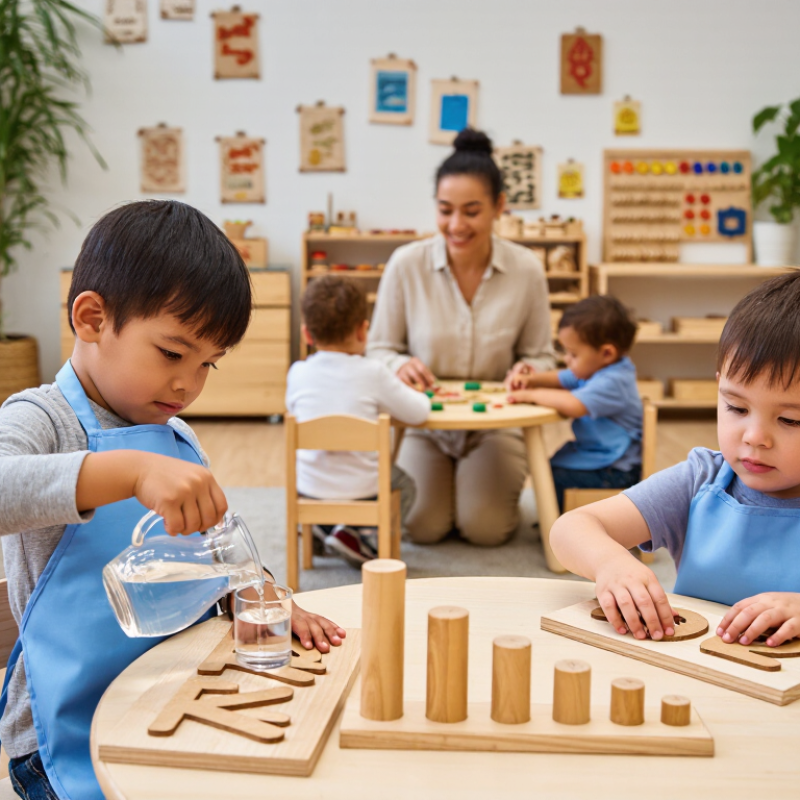
In Montessori classrooms, learning often begins with the hands before it reaches the page. A child may pour water between two small pitchers, trace a sandpaper letter, or sort wooden cylinders by size. These simple actions build concentration, coordination, independence, and early reasoning. The materials are not toys alone. They are carefully designed tools that invite children to notice errors and try again.
This raises an important question: why is hands on learning important in montessori education? The answer involves more than keeping children busy. Practical activity connects abstract ideas with visible results. When a child counts beads, the quantity can be touched, moved, and checked. When a child washes a table, responsibility becomes a real routine rather than a verbal instruction. Montessori guides observe these moments, offer precise demonstrations, and then allow meaningful repetition.
The method is not flawless. Some children need more direct support, and not every material suits every learner. Classroom quality also depends on teacher preparation, respectful guidance, and carefully maintained environments. Still, research on active learning and long-standing Montessori practice suggests that purposeful movement can strengthen engagement and self-regulation. The following ten reasons explain why hands-on learning matters. They also invite reflection: are children truly discovering ideas, or merely completing activities? That distinction matters.
Top 10 Reasons Hands-On Learning Matters in Montessori
What Hands-On Learning Means in Montessori Education
In Montessori education, hands-on learning means thinking through movement, touch, and purposeful work. A child may pour water, sort wooden shapes, or trace sandpaper letters. These actions turn an abstract idea into something the hands can test. The material offers a clear task, but the child controls the pace. Small details matter. A steady grip, a spill, or a repeated attempt can reveal developing coordination and concentration.
This approach is not simply “learning by doing.” Each activity has a learning purpose, an ordered sequence, and room for independent correction. Teachers observe carefully before stepping in. They may change the setup, offer a brief demonstration, or wait. That restraint requires professional judgment. In a classroom, I have seen a child return to the same counting work for several mornings, then explain the pattern without prompting. The progress looked quiet, not dramatic.
Hands-on work also connects knowledge with daily life. Children measure ingredients, care for plants, classify natural objects, and map familiar places. These experiences can build language, mathematical reasoning, and practical confidence together. Yet the method is not perfect. Some children need more conversation, clearer modeling, or extra time with a concept. A beautiful material cannot replace a responsive adult. Montessori learning works best when careful observation guides the next invitation, even when the plan needs changing.
| No. | Reason | What Hands-On Learning Means | Montessori Classroom Example | Primary Developmental Benefit | Observable Indicator |
|---|---|---|---|---|---|
| 1 | Builds independence | Children use real materials and complete purposeful tasks with gradually reduced adult assistance. | Pouring water, fastening clothing, preparing a snack, or returning work to its place. | Self-care, responsibility, and confidence | Attempts a familiar task before asking for help. |
| 2 | Strengthens fine-motor control | Manipulating objects develops hand strength, coordination, precision, and controlled movement. | Using tongs, threading beads, transferring objects, or tracing geometric shapes. | Hand–eye coordination and preparation for writing | Uses tools with increasing accuracy and control. |
| 3 | Makes abstract ideas concrete | Children first experience concepts physically before representing them with symbols or language. | Combining quantity cards with objects or building numbers with place-value materials. | Mathematical and language comprehension | Explains an idea using materials, words, or drawings. |
| 4 | Encourages concentration | Purposeful activities invite sustained attention because the child is actively involved in the process. | Repeating a sorting, matching, polishing, or construction activity independently. | Attention span and persistence | Continues working despite a manageable mistake. |
| 5 | Supports self-correction | Materials or task results provide feedback, allowing children to notice and correct errors without immediate adult judgment. | A puzzle piece that does not fit or a sequence that does not match the intended pattern. | Problem-solving and metacognition | Checks work and tries a different approach. |
| 6 | Connects learning to daily life | Learning is linked to practical activities that children can recognize and use outside the classroom. | Washing a table, arranging flowers, caring for plants, or preparing food. | Practical judgment and functional knowledge | Transfers a classroom skill to home or community routines. |
| 7 | Develops sensory discrimination | Children compare qualities such as size, shape, texture, sound, weight, color, or temperature through direct experience. | Grading objects by size, matching fabrics, identifying sounds, or sorting colors. | Observation and classification | Uses precise descriptive words for differences. |
| 8 | Promotes active language learning | Objects and actions give children concrete references for naming, describing, sequencing, and communicating ideas. | Naming objects, matching labels, sequencing picture cards, or describing a practical process. | Vocabulary and oral expression | Describes actions and materials in an increasingly specific way. |
| 9 | Builds executive-function skills | Children plan steps, manage materials, follow sequences, control impulses, and complete a chosen activity. | Selecting work, gathering required items, following a sequence, and restoring the workspace. | Planning, working memory, and self-regulation | Follows multi-step directions with fewer reminders. |
| 10 | Encourages collaboration and care | Shared practical work teaches children to respect people, materials, shared spaces, and different working rhythms. | Taking turns, carrying materials carefully, helping a peer, or caring for a classroom environment. | Social responsibility and respectful behavior | Waits, cooperates, and restores shared materials. |
Note: In Montessori education, hands-on learning refers to purposeful, self-directed interaction with concrete materials, practical activities, and real-life experiences. The developmental benefits listed above are commonly associated with these learning processes; individual outcomes vary according to age, readiness, environment, and guidance.
Children practice real tasks, such as pouring water, buttoning coats, and arranging small tables.
Simple actions develop balance, coordination, focus, persistence, and responsibility through repeated practice.
Demonstrate slowly, offer one task, then step back and observe.
No. Let children notice spills, adjust their grip, and try again.
A spill creates visible feedback. The child can pause, adjust, and attempt the transfer again.
Child-sized tools, small containers, light trays, and simple objects support safer, clearer practice.
Keep the workspace calm, remove distractions, and allow enough time for careful movements.
Ask, “What could you try next?” This encourages thinking without taking over.
No. Some children need slower demonstrations, simpler tools, or different learning approaches.
Yes, sometimes. Observation matters, because a familiar task may need adjustment or a fresh challenge.
Hands-on learning is a central part of Montessori education because it allows children to understand ideas through direct action, exploration, and purposeful practice. Instead of only listening to explanations, children work with carefully designed materials that help them develop coordination, independence, and practical life skills. They learn to make choices, complete tasks step by step, and take responsibility for their work. This approach answers the question, “why is hands on learning important in montessori education,” by showing how active participation turns learning into a meaningful and personal experience.
Sensory activities also help children notice differences in size, shape, texture, sound, and quantity, making abstract concepts easier to understand and remember. As children repeat activities, they strengthen concentration, patience, problem-solving abilities, and confidence. Most importantly, Montessori hands-on work connects classroom learning with everyday life, helping children use skills such as organizing, measuring, caring for their environment, and making thoughtful decisions in practical situations.

 Deri Toys
