In 2026, Montessori classrooms need materials that invite purposeful action, not simply attractive screen-free entertainment. A child tracing a sandpaper letter, sorting wooden cylinders, or pouring water into a narrow glass experiences feedback through movement. This raises an important question: how can montessori toys support classroom learning?
Research supports carefully designed, hands-on learning. Lillard and Else-Quest’s 2006 study, published in Science, found stronger academic and social outcomes among Montessori pupils than comparable children in the study. The Education Endowment Foundation’s Teaching and Learning Toolkit reports that collaborative learning can produce approximately five additional months of progress, although outcomes vary by implementation. UNICEF and the LEGO Foundation’s Learning through Play guidance also links active play with cognitive, social, emotional, and physical development. These reports do not prove that every Montessori toy works.
Angeline Stoll Lillard, a leading Montessori researcher, explains, “Montessori education is a method of education based on self-directed activity, hands-on learning, and collaborative play.” Her research reminds teachers to examine the learning process, not the toy’s wooden finish. Maria Montessori expressed the principle more simply: “The hands are the instruments of man’s intelligence.” That idea remains practical in a classroom. A bead chain can strengthen counting, sequencing, and concentration. A practical-life tray can develop coordination and independence. Still, selecting materials is not effortless. Some toys look Montessori-inspired but offer little meaningful choice or correction of error. This guide examines the 2026 classroom options with cautious optimism, focusing on evidence, durability, accessibility, and observable learning rather than marketing claims.
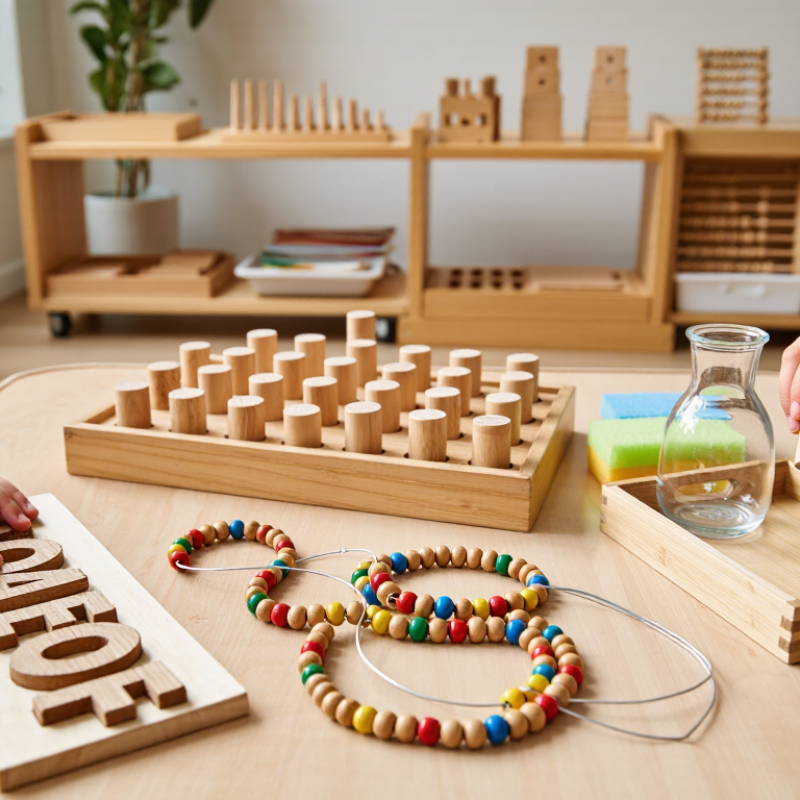
Montessori toys are hands-on learning materials designed to build independence, concentration, and practical understanding. In a classroom, children may sort wooden shapes, pour dry beans, match textured cards, or arrange number rods. Each activity has a clear purpose, not just bright entertainment. Small details matter.
A well-prepared shelf keeps materials visible, reachable, and limited in quantity. Children choose an activity, use it carefully, and return it when finished. Many materials offer built-in control of error, such as a puzzle piece that fits only one space. This feature helps children notice mistakes without waiting for adult correction. Teachers still observe closely, because a material can be too easy, too difficult, or poorly matched to a child’s development.
In my classroom experience, practical-life materials often create the strongest engagement. A child wiping a table may repeat the motion for ten minutes, improving coordination and patience. Another child may lose interest quickly. That is useful information, not failure. It suggests changing the presentation, simplifying the steps, or offering more time. Montessori toys should support purposeful action, not replace meaningful relationships. Safe materials, careful supervision, and accurate observation remain essential, especially in mixed-age classrooms. The room teaches too.
2026 Top Montessori Toys for Classroom Learning?
Key Criteria for Choosing the Best Montessori Toys in 2026
The best Montessori toys should invite purposeful action, not passive entertainment. Children should sort, pour, build, match, and correct mistakes independently. A 2018 American Academy of Pediatrics clinical report links simple, hands-on toys with stronger caregiver interaction and richer language development. In a classroom, a wooden pouring set may support concentration, fine-motor control, and practical confidence. Small details matter, including smooth edges, clear size differences, and trays that fit children’s hands.
Safety and developmental fit require careful checking. The European Commission’s 2023 Safety Gate report recorded more than 3,400 dangerous product alerts, showing why teachers should inspect materials, coatings, magnets, and small parts. Choose toys with transparent safety information and age guidance. Avoid confusing complexity. A toy with one clear challenge often teaches more than a crowded activity box.
Evidence should guide purchasing, but evidence is not perfect. Grand View Research projects strong growth in the global educational toys market through 2030, reflecting rising demand for learning-focused products. Growth alone does not prove quality. Teachers should observe whether children return to the material, solve problems, and cooperate with peers. Rotate fewer toys, record classroom observations, and ask families about accessibility needs. I would also reconsider natural materials as an automatic advantage; durability, hygiene, repairability, and inclusive design deserve equal weight.
In 2026, Montessori classroom learning works best when materials match children’s developmental needs. For ages three to four, practical-life toys build coordination and independence. Pouring sets, dressing frames, and simple sorting trays invite careful hand movements. Small brushes and wooden tongs make ordinary tasks feel meaningful. Keep choices limited. Too many objects can distract young learners.
Children aged four to five often benefit from sensorial and language materials. Knobbed cylinders, texture boards, sound containers, and movable alphabet pieces refine perception and early communication. A child may compare rough and smooth cards, then describe the difference aloud. For ages five to six, math and cultural materials can extend concentration. Number rods, bead chains, pattern blocks, maps, and nature cards support counting, sequencing, geography, and observation. Use real classroom examples. A child arranging ten beads may understand quantity more deeply than one completing a worksheet.
Age ranges remain flexible. Development is not a straight line. I have seen a younger child manage a complex puzzle while an older child needed more time with pouring. That surprised me. It also reminded me to observe before increasing difficulty. One common mistake is choosing attractive materials without checking their learning purpose. Each item should have clear steps, durable construction, and room for self-correction. Adults should demonstrate slowly, then step back. The classroom becomes more effective when children can repeat, adjust, and try again without embarrassment.
Top Montessori toy categories by typical classroom age range and primary learning skill
The age ranges reflect common Montessori classroom groupings: toddler, primary, and lower elementary. Practical life, sensorial, language, mathematics, and cultural materials are selected according to children’s developmental readiness, so actual classroom use may overlap between age groups.
A well-prepared Montessori shelf should feel calm, not crowded. I place one activity per tray, with every piece visible and reachable. Practical-life tools stay near a small table. Sensorial materials need open floor space. Language and counting materials work better under natural light. This arrangement reflects Montessori observation: follow the child, then adjust the environment. The UNICEF and LEGO Foundation Learning Through Play report identifies five essentials, including active engagement, joy, and meaningful interaction. These principles support purposeful toy presentation.
I rotate materials after observing repeated misuse, long waiting, or fading interest. A classroom does not need constant novelty. OECD early-childhood guidance emphasizes intentional learning environments and educator observation. I usually keep familiar materials while changing one challenge, such as adding a longer sequence or a new sorting rule. A 2023 UNESCO education report also stresses that learning resources should serve clear developmental goals, not decoration. Still, rotation is not always perfect. Some children need more time than my planned cycle allows. That deserves reflection.
Use a simple log with the date, material, child response, and next adjustment. Keep three to five choices on a small shelf, depending on age and room size. Repair loose parts quickly. Remove confusing extras. The best Montessori toys invite concentration, coordination, and self-correction. The shelf should quietly answer one question: what can the child do independently today?
In 2026, strong Montessori toys should support independence, concentration, and real classroom use. I look for natural textures, simple forms, and activities with a clear purpose. A wooden sorting tray, for example, can help children compare size, color, and weight. Safety comes before appearance. Teachers should inspect edges, loose parts, paint, fasteners, and cleaning instructions before each term. Toy materials should meet applicable child-safety standards and include clear age guidance.
Sustainability also needs practical attention. Durable wood, responsibly sourced fibers, and repairable designs can reduce classroom waste. Yet “eco-friendly” labels are not enough. Educators should check material information, packaging, production claims, and replacement policies. A toy that breaks after two weeks is not sustainable, even if its packaging is recyclable. I have found that storing pieces in open, labeled baskets helps children care for materials and makes missing parts easier to notice.
Inclusive Montessori practice requires more than adding different skin tones to dolls. Toys should offer varied grips, strong visual contrast, tactile clues, and quiet alternatives for children with different sensory needs. Activities can represent diverse homes, languages, abilities, and family structures without turning culture into decoration. Some traditional Montessori materials may need thoughtful adaptation. That can feel imperfect. It is still better than treating one design as suitable for every learner. Teachers should observe children, invite feedback, and adjust the environment regularly.
| Montessori Material or Toy Type | Typical Classroom Age | Primary Learning Purpose | Key Safety Checks | Sustainable Selection Criteria | Inclusive Montessori Practice | Recommended Classroom Use | Cleaning and Maintenance |
|---|---|---|---|---|---|---|---|
| Practical-Life Pouring Set | 2.5–5 years | Hand–eye coordination, concentration, controlled movement, sequencing, and independence. | Use stable containers with smooth, unbroken edges. Check that handles are securely attached. Supervise children under three around small removable parts and liquid spills. | Prefer durable glass only when appropriate for the group; otherwise choose long-lasting food-contact-safe metal or solid wood. Select repairable components and avoid unnecessary mixed-material parts. | Offer lightweight alternatives, larger handles, seated and standing work options, and visual or tactile demonstrations. | Present one complete activity on a tray. Start with dry transfer or empty pouring before introducing water. | Wipe and dry after each use. Wash containers according to the material’s care instructions and inspect trays for splinters or cracks. |
| Cylinder Block or Knobbed Inset | 2.5–4.5 years | Visual discrimination, pincer grasp, size comparison, and preparation for writing. | Knobs must be firmly secured and large enough for the intended age group. Check wooden surfaces for splinters, loose coatings, and sharp corners. | Choose solid, responsibly sourced wood with a durable water-based finish where available. Avoid disposable plastic packaging and replace only damaged components. | Provide high-contrast versions, tactile access, enlarged handles, and sufficient table space for children with motor or visual needs. | Use one block at a time for focused matching. Allow children to repeat the work without unnecessary correction. | Dust with a soft cloth. Use a lightly damp cloth when permitted by the finish; do not soak unfinished wood. |
| Color-Matching Tablets | 3–6 years | Color recognition, classification, visual memory, language development, and refinement of observation. | Use non-toxic, fully cured coatings. Check for peeling paint, loose caps, and small detachable pieces. Small parts require age-appropriate supervision. | Look for replaceable color surfaces, sturdy cases, low-packaging designs, and materials that can remain in use for several classroom cycles. | Include varied skin-tone and culturally responsive color discussions without presenting one naming system as universal. Offer tactile and verbal alternatives. | Begin with matching pairs, then progress to grading shades and describing colors using the children’s own observations. | Clean with a dry or slightly damp cloth. Keep tablets separated so surfaces do not rub and chip. |
| Pink-Tower-Style Cubes | 3–5 years | Visual discrimination of dimension, sequencing, balance, coordination, and mathematical preparation. | Inspect every cube for cracks, splinters, unstable paint, and sharp edges. Provide a clear floor area to reduce tripping and falling-object risks. | Prefer solid, repairable wood and water-based finishes. Avoid materials that cannot be separated or repaired when one component is damaged. | Provide a smaller or lighter sequence, floor markers, seated sorting, and peer collaboration without requiring every child to lift the full set. | Demonstrate slow, careful carrying. Invite children to build, compare, and self-check rather than treating speed as success. | Keep dry and store cubes so corners are protected. Refinish or remove damaged pieces according to classroom policy. |
| Number Rods and Counting Materials | 4–6 years | One-to-one correspondence, quantity, number sequence, comparison, and early mathematical reasoning. | Use securely bonded sections and smooth ends. Check long rods for cracks and ensure the work area is free from obstacles. | Select durable wood or recycled-content materials with documented composition. Favor sets with replaceable pieces and minimal plastic wrapping. | Use raised markings, tactile counting objects, large-print number cards, and multiple communication modes for mathematical explanations. | Move from concrete counting to matching symbols and quantities. Let children work on a mat or table at a comfortable height. | Wipe rods and cards regularly. Store long pieces horizontally or in a supported rack to reduce warping. |
| Sandpaper Letter Tablets | 3.5–6 years | Phonemic awareness, sound–symbol association, letter formation, and preparation for handwriting. | Ensure sandpaper is firmly bonded and does not shed excessive particles. Use age-appropriate letter forms and check wooden edges for splinters. | Choose replaceable surfaces, responsibly sourced wood, and low-odor finishes. Avoid sets that require replacing the entire collection when one tablet wears out. | Offer tactile, visual, auditory, and sign-supported introductions. Include the writing system and languages represented by the classroom community where appropriate. | Introduce a small number of letters at a time. Pair tracing with the letter sound and allow alternative response methods. | Keep dry and dust lightly. Do not use harsh chemicals that may weaken the textured surface. |
| Geometric Cabinet Insets | 3–6 years | Shape discrimination, visual analysis, vocabulary, grasp refinement, and preparation for geometry. | Check knobs, frames, and inset edges. Remove pieces with loose hardware, sharp points, or chipped coatings. | Prioritize solid or laminated wood that can withstand repeated handling. Choose modular replacement parts and packaging made from recyclable fiber where available. | Provide contrasting backgrounds, tactile shape outlines, adapted knobs, and floor or tabletop presentation choices. | Present matching, tracing, and shape-language activities. Connect shapes to objects in the children’s environment. | Wipe surfaces regularly and store pieces in their matching frames to prevent loss and edge damage. |
| Threading and Lacing Work | 3–6 years | Fine-motor control, bilateral coordination, concentration, dressing preparation, and sequencing. | Inspect cords for fraying and confirm that ends are securely finished. Keep beads and other small parts away from children who still mouth objects. | Use washable fabric, durable cord, and repairable fasteners. Avoid PVC-based materials when a safer, reusable alternative meets the same purpose. | Offer thick cords, larger holes, magnetic or hook-and-loop alternatives, and stabilized bases for children with reduced hand strength. | Begin with simple threading and progress to patterns or lacing cards. Provide individual trays to reduce tangling. | Wash fabric components according to care instructions. Replace frayed cords immediately and count small components after use. |
| Puzzle Maps and Cultural Geography Materials | 3–6 years | Spatial awareness, geography vocabulary, classification, cultural understanding, and visual memory. | Check knobs, edges, and map pieces for secure construction. Confirm that printed information is accurate, current, and free from harmful stereotypes. | Choose long-life boards, replaceable map pieces, water-based finishes, and recyclable packaging. Digital printing should not replace hands-on access for all learners. | Use respectful, current names and pronunciation support. Include multiple perspectives and avoid presenting political borders or cultures as fixed or superior. | Combine map work with stories, photographs, music, and real objects while distinguishing cultural learning from token displays. | Keep pieces flat and dry. Store maps in labeled compartments and review content periodically for accuracy and inclusiveness. |
| Open-Ended Natural Loose Parts | 3–6 years, with close supervision for younger children | Imagination, classification, engineering thinking, storytelling, collaboration, and problem-solving. | Use only clean, non-toxic, age-appropriate objects. Exclude choking hazards for children under three, sharp objects, treated plant material, mold, and unstable heavy items. | Collect responsibly and legally. Prefer locally available, renewable, reclaimed, or reusable materials, and avoid removing living habitat or protected natural objects. | Offer varied sizes, textures, weights, and tools. Accept construction, drawing, verbal explanation, or collaborative participation as valid outcomes. | Provide clear limits for quantity and use. Invite children to sort, build, narrate, and restore the materials independently. | Inspect before every session. Wash or wipe suitable items, dry completely, and discard any material showing mold, cracks, sharp edges, or contamination. |
| Sound Cylinders or Listening Materials | 3–6 years | Auditory discrimination, concentration, matching, volume comparison, and language development. | Ensure sealed containers cannot open during normal use. Avoid excessive sound levels and inspect for rattling parts, cracks, or leakage. | Select durable refillable designs where safe and appropriate. Prefer repairable containers and avoid unnecessary batteries or electronic components. | Pair auditory work with visual or tactile cues. Offer quiet alternatives and do not penalize children whose hearing access differs from the group norm. | Use short, quiet listening sessions. Present matching and grading activities with a defined workspace. | Wipe exterior surfaces and check seals regularly. Remove any cylinder that opens, leaks, or produces an unexpectedly loud sound. |
| Moveable Alphabet or Word-Building Set | 4.5–6 years | Phonetic spelling, word construction, reading preparation, vocabulary, and self-expression. | Check that letters are large enough for safe handling and that paint or printed labels do not peel. Store small pieces securely when not in use. | Choose durable, replaceable letters made from responsibly sourced wood or recycled-content material. Avoid sets with excessive single-use packaging. | Include the classroom’s relevant languages and scripts when feasible. Offer uppercase and lowercase formats, tactile markings, and speech-to-text or picture-supported options. | Begin with sound-based word building and progress to phrases. Accept invented spelling as part of early composition and provide respectful guidance. | Count and sort letters after each session. Wipe clean and replace damaged pieces rather than discarding the complete set. |
| Balance and Movement Equipment | 2.5–6 years | Gross-motor coordination, balance, body awareness, risk assessment, and confidence. | Use equipment on a clear, level, non-slip surface. Follow the manufacturer’s weight and use instructions, inspect fasteners, and maintain active adult supervision. | Prefer repairable, durable materials and equipment designed for repeated institutional use. Select items that can be used without batteries or disposable parts. | Offer different heights, widths, hand supports, and movement pathways. Participation may include observing, assisted movement, or adapted equipment. | Teach safe carrying, waiting, spacing, and stopping rules. Allow children to choose an appropriate challenge instead of rewarding unsafe speed. | Inspect before use, clean high-touch surfaces, tighten hardware as required, and remove damaged equipment immediately. |
It invites purposeful action, such as sorting, pouring, building, or matching. Children should work independently and notice mistakes. Passive entertainment is less useful.
Practical-life materials work well, including pouring sets, dressing frames, sorting trays, brushes, and wooden tongs. Keep the choices limited. Too many objects distract some children.
Sensorial and language materials can refine perception and communication. Texture boards, sound containers, knobbed cylinders, and movable letters offer clear comparisons. A child might describe rough and smooth cards aloud.
Number rods, bead chains, pattern blocks, maps, and nature cards support counting and observation. Ten arranged beads can show quantity more clearly than a worksheet. Sometimes, simple materials teach more.
Inspect edges, loose parts, paint, fasteners, magnets, and cleaning instructions. Check age guidance and available safety information. Small pieces need careful supervision.
Not automatically. Durability, hygiene, repairability, and inclusive design also matter. A wooden toy that breaks quickly is not a strong sustainable choice.
Choose varied grips, clear visual contrast, tactile clues, and quiet alternatives. Materials should reflect different abilities, languages, homes, and family structures. One design cannot suit every learner.
Demonstrate slowly, then step back. Observe whether children repeat, adjust, cooperate, and solve problems. I once increased difficulty too soon. That was a mistake.
Store pieces in open, labeled baskets. Children can return materials more easily, while teachers notice missing parts quickly. Rotate fewer toys and record classroom observations.
This guide explores how Montessori toys can turn the classroom into an inviting environment for purposeful, hands-on learning. It explains what Montessori toys are, how can montessori toys support classroom learning, and how carefully designed materials can encourage independence, concentration, problem-solving, fine-motor development, language growth, early mathematics, and practical life skills. It also presents key criteria for selecting the best options in 2026, including developmental suitability, simplicity, durability, open-ended use, cultural relevance, and alignment with classroom goals.
The article organizes toy categories by age and learning skill, helping educators choose materials for toddlers, preschoolers, and early elementary learners. It also offers practical guidance on arranging, presenting, observing, and rotating toys without overwhelming children. Finally, it addresses safe construction, sustainable materials, hygiene, accessibility, and inclusive practices so every child can participate confidently in a respectful and engaging Montessori classroom.
