Choosing Montessori toys well requires more than attractive wood, muted colors, or the Montessori label. A thoughtful buyer should ask what makes a high quality montessori toy before purchasing. The answer usually involves purposeful design, safe materials, accurate sizing, and meaningful opportunities for independent play. A simple wooden knob puzzle, for example, should fit small hands comfortably and challenge a child without creating unnecessary frustration. The toy should invite action, not merely decorate a shelf.
Quality also depends on evidence and careful observation. Montessori educators and child development specialists often recommend toys that isolate one skill, encourage concentration, and allow children to notice their own mistakes. Reliable manufacturers provide clear age guidance, material information, smooth finishes, and consistent construction. Look closely at the details: rounded edges, secure parts, balanced weight, and paint that does not easily chip. These small features matter during daily use.
Still, no toy is perfect. A beautifully crafted activity may be unsuitable if it is too advanced, too repetitive, or mismatched with a child’s interests. Personal experience can reveal this quickly; a toy ignored after two minutes may need a different presentation, not immediate replacement. Parents should also question marketing claims and compare independent reviews with professional guidance. Choosing wisely means observing the child, checking the product, and accepting that quality is connected to real use, not appearance alone.
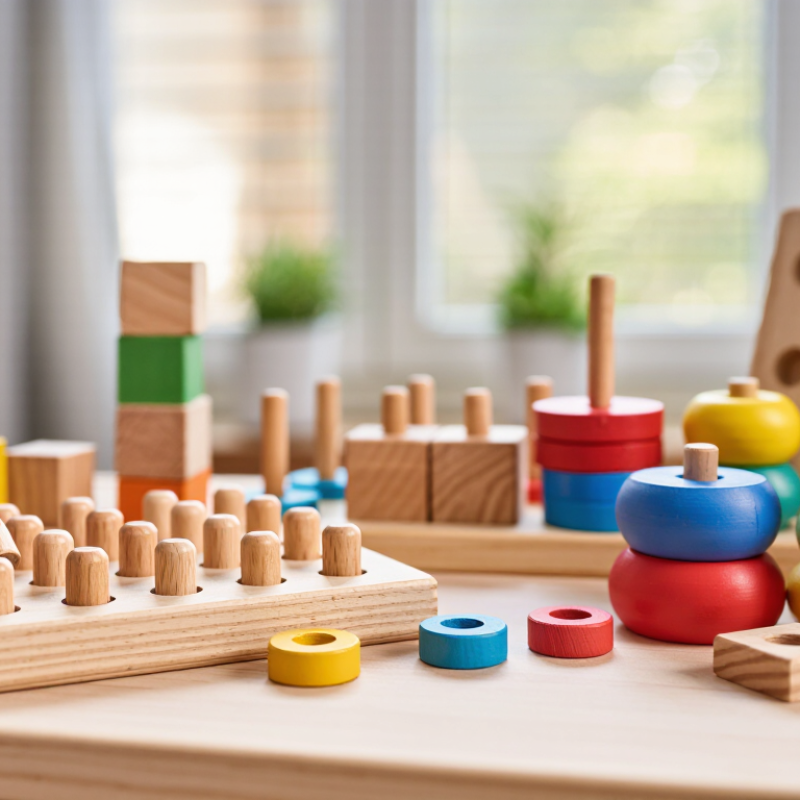
How to Choose High Quality Montessori Toys?
Montessori toy design begins with purposeful simplicity. UNICEF’s Learning Through Play report describes effective play as joyful, meaningful, active, iterative, and socially interactive. A strong toy should support these qualities without flashing lights or constant adult direction. Look for one clear task, such as transferring beans with a small spoon or matching wooden cylinders. The child should notice the challenge quickly.
Material choice also matters. Smooth wood, firm stitching, rounded edges, and non-toxic finishes support safe, repeated handling. UNICEF reports that about 90% of brain development occurs before age five, making early sensory experiences especially important. However, “natural” does not automatically mean high quality. A rough edge remains a rough edge. Check weight, joinery, odor, and cleaning instructions. These small inspections reveal more than attractive packaging.
Montessori design also respects control of error. A child should discover a mismatch independently, rather than waiting for praise. Choose toys with one manageable difficulty and enough room for experimentation. The UNICEF report emphasizes active engagement and iteration, which means repetition is valuable, not boring. In practice, I would observe whether a child returns to the toy after failure. That response can be more useful than an age label. I still question overly strict Montessori claims; children differ, and one “correct” presentation cannot fit every home. A quiet shelf helps. So does patient observation.
| Evaluation Dimension | Core Montessori Principle | What to Look For | Practical Quality Check | Recommended Assessment |
|---|---|---|---|---|
| Purposeful Design | Activities should support a clear developmental purpose rather than provide random stimulation. | A focused task such as sorting, transferring, matching, threading, or building. | Ask whether the toy offers one understandable challenge and can be used without unnecessary electronic effects. | High priority |
| Child-Led Exploration | Children should be able to choose, repeat, and complete activities at their own pace. | Open access, manageable pieces, and instructions that do not require constant adult direction. | Observe whether a child can begin using the toy after a brief demonstration. | High priority |
| Hands-On Learning | Concrete manipulation helps children connect physical actions with concepts. | Materials that involve grasping, pouring, arranging, stacking, or other purposeful hand movements. | Check that the pieces are comfortable to hold and that the action produces a noticeable result. | High priority |
| Control of Error | The design should help children notice and correct mistakes independently. | Self-checking features such as pieces that fit only when correctly matched or a visible completed pattern. | Determine whether the child can identify an incorrect result without an adult giving the answer. | High priority |
| Single or Limited Focus | One main challenge at a time reduces distraction and supports concentration. | Simple layouts, limited visual noise, and clearly differentiated components. | Look for a direct relationship between the child’s action and the learning objective. | High priority |
| Realistic Materials and Forms | Concrete, recognizable objects can help children understand the real world. | Natural shapes, functional tools, realistic color relationships, and familiar everyday activities. | Check whether the toy represents a meaningful object or process instead of relying only on fantasy decoration. | Recommended |
| Material Quality | Durable, orderly materials encourage careful handling and repeated use. | Smooth surfaces, stable construction, secure joints, and components that maintain their shape. | Inspect for splinters, sharp edges, loose parts, peeling coatings, and excessive wobbling. | Essential |
| Safety and Age Suitability | Activities should match the child’s developmental stage and physical abilities. | Clear age guidance, appropriately sized parts, non-toxic finishes, and no accessible hazardous components. | Follow the manufacturer’s safety guidance and check for small parts when the toy is intended for older children. | Essential |
| Movement and Coordination | Practical movement supports fine-motor control, hand-eye coordination, and independence. | Tasks involving grasping, fastening, transferring, balancing, or controlled placement. | Confirm that the level of resistance is challenging but does not require excessive force. | Recommended |
| Progressive Challenge | Materials should allow children to move from simple actions toward more complex skills. | Adjustable difficulty, multiple arrangements, or extensions that build on earlier learning. | Check whether the toy remains useful after the child masters the basic activity. | Recommended |
| Independence and Practical Life | Children benefit from activities connected to real responsibilities and everyday routines. | Child-sized tools or simulations of dressing, cleaning, pouring, organizing, or food preparation. | Assess whether the activity develops a useful skill instead of only rewarding button pressing. | High priority |
| Order and Storage | A predictable place for each material supports organization and independent choice. | Complete sets, manageable quantities, trays, compartments, or clearly defined storage spaces. | Verify that the child can return every component without adult assistance. | Recommended |
| Low Electronic Dependence | Active manipulation and concentration should remain central to the learning experience. | Limited reliance on flashing lights, automatic sounds, screens, or predetermined responses. | Ask whether the toy remains engaging and educational when batteries or electronic features are removed. | Recommended |
| Long-Term Use | Well-designed materials should support repeated practice and meaningful discovery. | Robust construction, timeless activities, and opportunities for different levels of use. | Consider whether the toy can be reused in new ways without losing its original purpose. | Recommended |
It offers one clear task, such as transferring beans with a spoon. The challenge should be easy to notice. Avoid flashing lights and constant adult direction. Simple works well.
Look for smooth wood, firm stitching, rounded edges, and non-toxic finishes. Check the toy’s weight, joins, smell, and cleaning instructions. Natural materials are not automatically safe or durable. A rough edge remains a problem.
Children should notice mistakes without waiting for praise. Matching pieces, sorting objects, and fitting shapes can provide this control of error. Choose one manageable difficulty. Too many challenges may discourage small hands.
Repeating a task builds concentration and supports gradual improvement. Pouring beans between three cups may look simple, but it develops control. Watch whether the child returns after failure. That response may matter more than an age label.
Yes, with careful supervision. A wooden tray, three cups, and dry beans can support counting and transferring. A plain bowl may hold attention longer than an expensive toy. That surprised me, honestly.
Focus on the child’s action, not attractive packaging. Useful actions include sorting, pouring, matching, building, and careful hand movement. The toy should leave room for experimentation. It should not provide every answer.
Blocks might become a bridge, animal shelter, or pretend kitchen. One material can support several kinds of thinking. Open-ended use encourages imagination and interaction. Still, some children may ignore the same set.
Check rounded edges, secure parts, washable surfaces, and clear cleaning guidance. Make sure the child can carry and return the toy safely. Supervision remains essential, especially with small objects. No checklist is perfect.
Choosing a high-quality Montessori toy begins with understanding the principles behind its design: simplicity, purposeful learning, hands-on exploration, and respect for a child’s natural development. The key question is what makes a high quality montessori toy? It should be made from safe, non-toxic, age-appropriate materials, with sturdy construction, smooth surfaces, and carefully finished details. Its size, complexity, and challenge should match the child’s developmental stage without creating unnecessary frustration.
A valuable Montessori toy encourages independence, concentration, problem-solving, and creative discovery rather than relying on excessive lights, sounds, or fixed outcomes. Open-ended designs allow children to use the toy in different ways as their skills grow. Parents should also consider durability, sustainable materials, ease of care, and long-term usefulness. The best choice is not necessarily the most expensive option, but one that offers lasting educational value, supports meaningful play, and remains safe and engaging over time.

 Deri Toys
