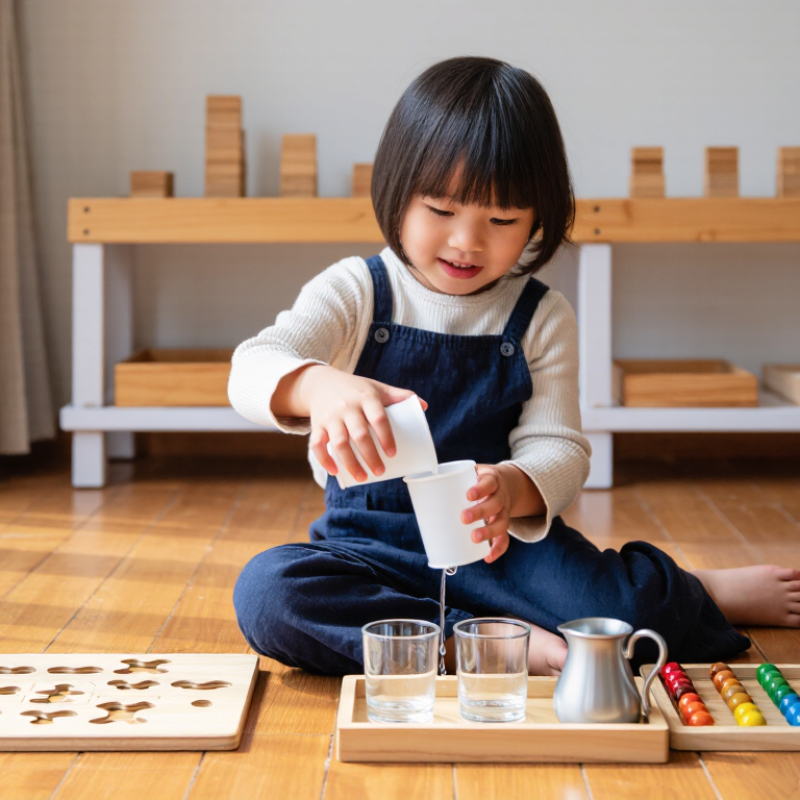
How can montessori toys encourage self confidence? The answer often begins with a small, visible success: a child pours water between two cups, fits the final puzzle piece, or returns a wooden bead to its tray. Toys with clear purposes and manageable challenges can let children choose, try, make mistakes, and try again. That process may support confidence, but no toy guarantees it. A child’s temperament, adult guidance, and the difficulty of the activity all matter.
Research offers useful context, with an important caveat. In a 2006 study published in Science, Angeline Lillard and Nicole Else-Quest compared children attending Montessori and conventional schools. The Montessori group showed stronger results in several measured areas, including executive function and social problem-solving. The study examined whole educational environments, not toys alone. It cannot prove that a particular toy builds self-confidence. Still, it supports the value of settings where children practice independent work. Small wins matter. So does room to struggle safely.
Dr. Maria Montessori, physician and educator, wrote, “The greatest sign of success for a teacher… is to be able to say, ‘The children are now working as if I did not exist.’” Her observation points toward independence, not simply praise. In 2026, families can use that idea when choosing toys: look for child-sized tools, simple materials, and tasks a child can repeat without constant adult correction. A useful toy may also be ignored, or prove too difficult. That is worth noticing. Confidence grows through real effort and supportive relationships, not a label on a box.
What Montessori Toys Are and How They Support Independent Learning
Montessori toys are simple, purposeful materials that invite children to choose, handle, repeat, and correct their own actions. They often use natural textures, realistic forms, and one clear challenge. A child may pour water, match shapes, or fasten a wooden frame without immediate adult help. This process supports independent learning because feedback comes from the activity itself, not constant praise. Small success matters. It can make a child feel capable.
This approach also connects with wider education research. The OECD’s PISA 2022 creative-thinking assessment covered nearly 690,000 students across 81 economies. The World Economic Forum’s Future of Jobs Report 2025 ranked creative thinking among the most important core workplace skills. These reports do not prove that Montessori toys create confidence. They do suggest that flexible thinking and self-direction deserve early practice. A toy can also become too controlling. That distinction is easy to miss. Adults should watch the child, not force a perfect method.
Tips: Choose one toy with one clear purpose. Place it on a low, open shelf. Demonstrate slowly, then step back. Let the child repeat the task, even when the pace feels inefficient. Use calm language such as, “You found another way.” Avoid correcting every movement. If frustration grows, simplify the activity or pause. No toy guarantees confidence. Consistent chances to try, fail, adjust, and try again are more convincing.
(UNICEF, Learning Through Play; OECD, PISA 2022; World Economic Forum, Future of Jobs Report 2025)
How Child-Led Play Builds Confidence Through Choice and Mastery
How Can Montessori Toys Encourage Self Confidence in 2026?
Child-led play gives children meaningful control over their learning. A child chooses a wooden puzzle, pours water, or sorts smooth stones by size. That decision matters. It tells the child, “My ideas are worth exploring.” In my observations, children often return to activities that challenge them slightly. They test, pause, adjust, and try again. Small successes gradually become personal evidence of capability.
Montessori-inspired materials often support this process through clear goals and manageable steps. A child may struggle to fit a cylinder into its matching opening. After several attempts, the final click creates visible satisfaction. The adult does not rush to praise every movement. Instead, the adult watches carefully, offers limited help, and protects the child’s concentration. This approach reflects child-development guidance about autonomy, repetition, and appropriately challenging tasks. Let them try.
Choice also requires thoughtful limits. Offering ten activities can overwhelm a young child, while offering two or three can make decisions easier. I once provided too many options, believing more freedom would build confidence. The child wandered between activities and finished none. That experience changed my approach. Confidence does not grow from constant success alone. It grows when children notice mistakes, repair them, and experience progress. A calm space, patient timing, and materials suited to the child’s abilities can make that progress visible. Mistakes belong there.
Which Toy Features Encourage Problem-Solving and Persistence
How Can Montessori Toys Encourage Self-Confidence in 2026?
Montessori-inspired toys can build confidence when their features reward effort, not speed. A child may sort wooden shapes, adjust a puzzle piece, and try again without adult correction. Self-correcting designs show errors clearly. They make persistence visible. Open-ended materials also allow several solutions, which supports independent thinking.
The OECD’s PISA 2022 creative-thinking assessment covered 64 education systems. Its findings connect creative performance with activities that involve imagining, evaluating, and improving ideas. These skills begin with small challenges. The 2022 National Assessment of Educational Progress reported mathematics declines of five points in grade four and eight points in grade eight, compared with 2019. Toys cannot repair that gap alone. They can offer daily practice with patterns, measurement, sequencing, and reasoning.
Useful features include graduated difficulty, removable parts, tactile feedback, and enough silence for concentration. A child should be able to pause, inspect the problem, and choose another method. Not every challenge works. If the instructions are too strict, exploration becomes compliance. If the task is too difficult, persistence may become frustration. Adults should observe before helping, then ask, “What could you try next?” The boundary is easy to miss. A toy can encourage confidence, yet still need thoughtful guidance, careful observation, and occasional redesign.
How to Select Montessori Toys for a Child’s Age and Abilities in 2026
Choosing Montessori toys in 2026 works best when age is a starting point, not a strict rule. A child’s hand control, attention, and interests offer useful clues. For toddlers, try large wooden rings, simple posting boxes, or chunky shape puzzles. These invite grasping, repetition, and visible results. Keep pieces too large to swallow, and stay nearby during play. Small wins matter.
For preschoolers, consider pouring sets, sorting trays, lacing cards, or puzzles with a few more steps. Choose tasks the child can attempt without constant adult help, but leave room for a little struggle. If a puzzle is solved instantly, add a harder one. If frustration takes over, simplify the task or demonstrate one move. Watch, then adjust.
Age labels can help, but children develop unevenly; one may sort confidently yet find small fasteners difficult. Notice what the child can do safely and where interest lasts. Offer one new challenge at a time, such as transferring beans with a spoon before trying tongs. Avoid turning play into a test. Sometimes a toy that seemed ideal stays untouched, and that is useful information too. Rotate it later or try a simpler activity.
How Caregivers Can Foster Confidence During Montessori Play
How Can Montessori Toys Encourage Self Confidence in 2026?
During Montessori play, confidence can grow through small, repeated moments of independence. A child carefully pouring water into a glass learns by doing, not by hearing every step explained. Caregivers can prepare reachable materials, show how to use them, then leave room for practice. Let them try.
A 2017 longitudinal study published in Frontiers in Psychology followed 141 children admitted to a public Montessori program through a lottery. Researchers reported stronger gains in several areas, including academic skills and social understanding, compared with children in conventional classrooms. The study supports Montessori’s potential, but it did not measure confidence as a single outcome. Encouraging, not conclusive.
Caregivers can notice effort with specific words: “You steadied the jug before pouring.” This keeps attention on the child’s choices, rather than adult approval. When a tower falls, pause before rebuilding it for them. Wait a little. Offer help if the child asks, or if frustration is rising. I may still step in too quickly when a spill seems avoidable; that reaction is worth noticing. A towel nearby can make the mess manageable, while the child gets another chance to pour.
FAQS
It usually has a simple purpose and one clear challenge. Natural textures, realistic shapes, and pieces a child can handle are common. A wooden shape sorter is one example.
Children choose an activity, try it, and repeat it at their own pace. The materials often show whether something fits or balances. Small successes matter.
Self-correcting pieces make mistakes easier to notice. Graduated difficulty, removable parts, and tactile feedback can invite another attempt. Open-ended materials allow different solutions.
Set materials within reach and demonstrate slowly. Then step back. Specific comments, such as “You steadied the jug,” recognize effort without taking over.
Not every time. Pause and observe before helping, so the child has room to adjust a puzzle piece or try another method. If frustration rises, simplify or pause.
Keep a towel nearby during pouring or other practical activities. A small spill can be manageable. I may still step in too quickly; that is worth noticing.
No toy guarantees either. Research on Montessori education suggests potential benefits, but it does not prove that toys alone create confidence. Context matters.
Pick one activity with a clear purpose, such as matching shapes or fastening a frame. Watch how the child responds. The right level of challenge can be hard to judge.
Conclusion
Montessori toys encourage children to learn through hands-on exploration, practical challenges, and choices they can make for themselves. When a child selects an activity, tries it independently, and sees their effort lead to progress, they can develop a stronger sense of capability. This explains how can montessori toys encourage self confidence: they give children room to practice skills, make mistakes, and experience small, meaningful successes at their own pace.
Toys with clear purposes, manageable challenges, and opportunities to solve problems can help children build persistence and concentration. In 2026, caregivers can choose activities suited to a child’s age, interests, and current abilities, adjusting the challenge as the child grows. During play, adults can support confidence by offering encouragement without taking over, allowing time for independent effort, and recognizing persistence as well as results. These simple choices help children feel capable, curious, and increasingly confident in their learning.

 Deri Toys
